
Portal news
The Zarocer blog is now live
Explore the new home for original game guides and practical browser gaming tips.
October 8, 2026 · ZarocerRead story
Tile Rummy 1.2.0 is live on Zarocer. Read the current variant, daily deal and reported old-save compatibility without changing the established game URL.
By Zarocer · October 12, 2026 · 7 min read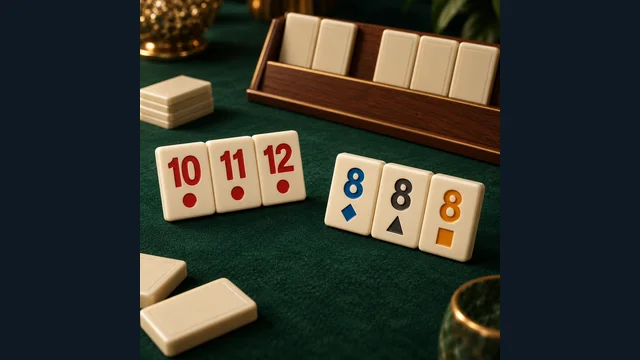
Zarocer has updated Tile Rummy from version 1.0.0 to 1.2.0 in the October 12 catalog release. The public game page and native build now refer to the newer version. The responsible release Work reported compatibility checks for old saves and a real Daily session as part of its validation. This announcement describes that verified transition and the rules returning players should read. It does not invent an itemized development history for every file in the new build or attribute undocumented features to the version number alone.
The game's identity and public route remain the same. Existing premium cover assets, portal navigation and the native save namespace were preserved within the reported release. There is no need to seek a newly named game page to continue. That stability is useful because a bookmark still leads to the correct title, while the version metadata distinguishes the updated build. A favorite remains a shortcut rather than an exported saved match, so players should still return through the browser and domain where their local progress was created.
Tile Rummy asks you to form groups of equal numbers in different suits or consecutive runs in one suit. Select at least three tiles and choose New combination. The first opening needs thirty points from your own rack. That opening condition matters: tiles already on the shared table do not substitute for the required rack contribution. Before confirming, inspect the values and arrangement rather than assuming that any three visually related tiles count. The native interface validates the rules of this digital edition.
After opening, you can add to rows and reorganize the shared table. Reuse every table tile and contribute at least one tile from your rack. That constraint prevents a visually clever rearrangement from becoming a legal turn if it loses a table tile or makes no rack progress. Empty your rack before the rival to win. The update does not turn this into a score-collection puzzle where rearranging repeatedly without contributing is sufficient. Read the current help when returning, especially if you last played a physical version with different house rules.
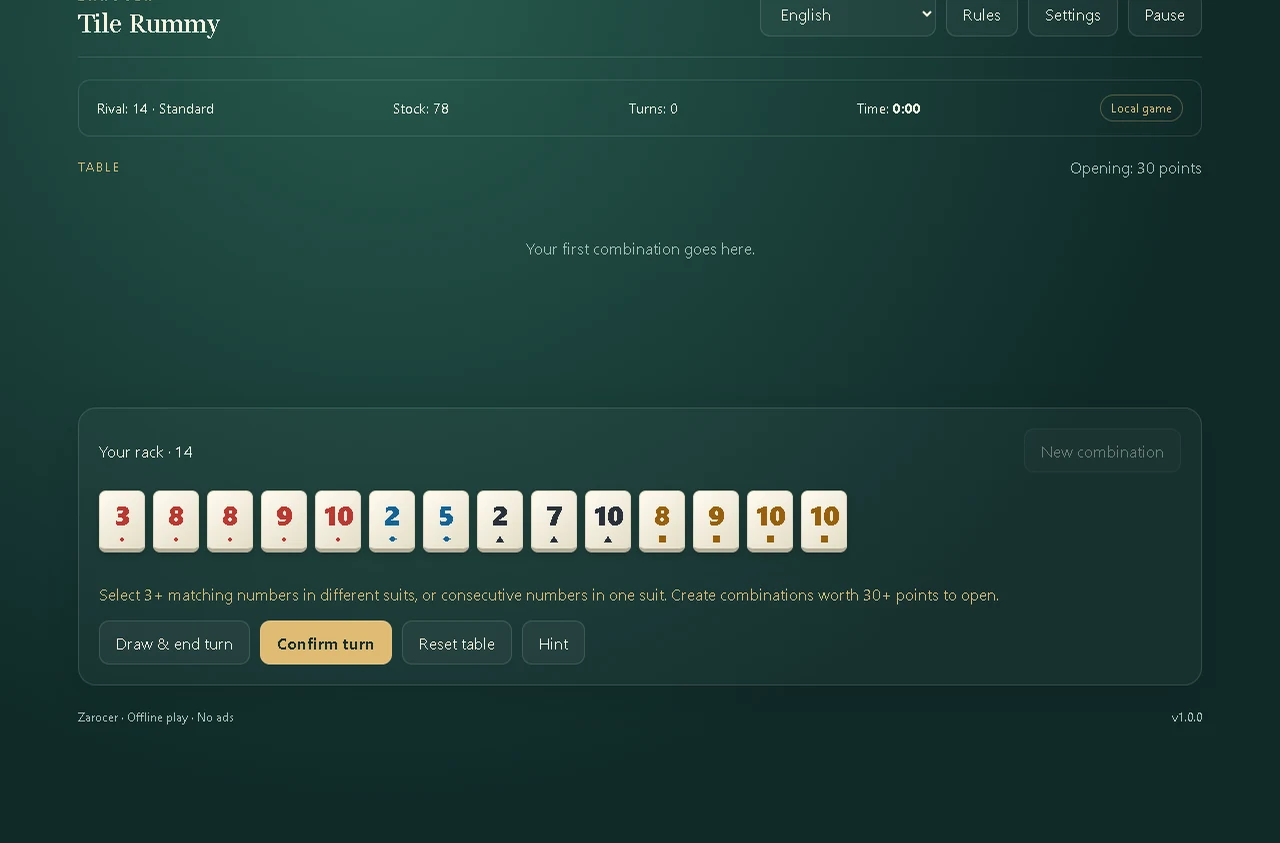
Taking rows apart can reveal useful combinations, but the final arrangement must remain valid. Consider the whole table, not only the run you want to extend. If moving a tile leaves another row too short or breaks its sequence, the attractive addition has not completed a legal turn. A practical approach is to state your intended final rows before dismantling them. You can then check whether every tile has a home and whether your own contribution creates the required change. This is advice about the current rules, not a claim that version 1.2.0 guarantees an automatic optimal arrangement.
The published description calls this an open-joker variant: jokers may move when the final table remains valid. Do not import a restriction from a different rulebook without checking this implementation. Equally, open-joker does not mean that an invalid or incomplete table is acceptable. The flexibility applies within the final validation. When a planned turn fails, inspect the leftover row, duplicated suit or missing tile before assuming the joker is the only cause. The game page and native rule panel are the appropriate references for the version actually being served.
Choose a relaxed rival while learning or a standard rival for a more demanding session. Those labels describe this game's modes, not a certified difficulty rating against other Rummy software. A useful first session after an update is one where you can inspect the opening requirement and shared-table behavior calmly. Once the interaction is familiar, choose the rival that suits the challenge you want. There is no requirement to select the harder option to benefit from the update or to validate that your saved match still opens.
The daily challenge uses the same UTC deal for everyone under the published rules. That provides a shared starting point, but the article does not announce a new public leaderboard or promise that every resumed attempt qualifies for competition. Daily gameplay, local record handling and the portal's ranking contract are different systems. The technical Work reported a real Daily validation; that supports the functionality within the tested scope. It does not justify activating unrelated ranking adapters or changing account behavior as part of an editorial announcement.
If you have a saved Tile Rummy match, return through the same browser and Zarocer domain with storage available. Use the native continuation option rather than starting another match merely because the version label changed. The release's reported old-save compatibility is encouraging, but each player's actual browser state still matters. Private browsing, cleared site data or switching devices can remove the context the game needs. No cloud transfer or recovery service is being announced. Avoid clearing data as a troubleshooting shortcut when the saved session is the thing you want to preserve.
A useful returning-player check is concrete: confirm that the saved rack and table appear, inspect whose turn it is and perform an ordinary legal action. If something unexpected happens, note the visible version and what action caused it before resetting. Do not share personal storage contents publicly. The responsible Work's tests show that the release preserved the intended compatibility paths; they do not make an unobserved historical save on every device automatically certified. Keeping that distinction clear makes the update report accurate rather than absolute.
Mouse, keyboard and touchscreen inputs are supported. Select the tiles you intend to use, create the combination and inspect the resulting rows before confirming a turn. If you cannot complete a valid contribution, drawing a tile ends the turn according to the native instructions. On a smaller display, give yourself time to distinguish selecting a rack tile from selecting a table row. The approved portal design and premium previews remain intact; the update is not an instruction to abandon the existing player or use a separate download.
Use pause when you need to stop and the native save behavior when returning. Restarting, leaving the expanded player and clearing browser data are different actions with different consequences. The player controls are not all substitutes for undoing a table arrangement. Read the current control labels instead of relying on a remembered gesture from another title. This is especially relevant when several games in the catalog support different kinds of touch interaction. Shared visual styling does not make their native rules or controls identical.
The technical report identifies Tile Rummy 1.2.0 as the published update and records old-save compatibility, public player checks and Daily validation within its tested scope. It also reports preservation of the prior catalog and visual protections. This article uses those facts without claiming that a new progression system, cloud sync or remote multiplayer arrived. The existing source includes several technical files, but a filename alone is not a documented user-facing feature. News should distinguish an observed capability from something that merely appears in an implementation tree.
For a different decision style, Farkle offers a solo banking choice across ten turns, while Kōnane focuses on preserving future legal jumps. Those games are alternatives for a new session, not replacements for a saved Tile Rummy match. Returning players can stay on the established page, verify version 1.2.0, read the actual variant rules and continue locally where supported. Future changes should receive their own factual notes when published. This report closes the current update with a clear boundary: the build changed, the game identity remained stable and the tested compatibility was preserved.
Open Tile Rummy and its current controls
Explore the new home for original game guides and practical browser gaming tips.
October 8, 2026 · ZarocerRead story
Two-column mobile category grids, a visual category directory and answers to common playing questions.
October 8, 2026 · ZarocerRead story
Flag Quiz’s October 10 catalog release brings 20-question rounds, 30 flags, missed-answer review and a UTC daily challenge. Explore the available build.
October 11, 2026 · ZarocerRead story
Explore Atlas Sprint’s October 10 catalog release: 93 selectable countries, continent practice, map controls and a 12-country daily challenge.
October 11, 2026 · ZarocerRead story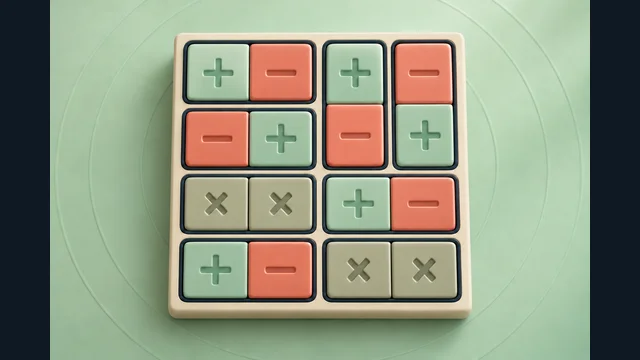
Magnets Puzzle’s October 10 catalog release combines paired poles, exact row and column clues, progressive campaign boards and a UTC daily puzzle.
October 11, 2026 · ZarocerRead story
Untangle Puzzle’s October 10 release offers 24 Journey stages, a daily network and a 90-second mode. See the real English board and available controls.
October 11, 2026 · ZarocerRead story
Number Ladder’s October 10 catalog release brings checkpoint paths, a 12-level Journey, practice sizes and a shared daily 5 × 5 board.
October 11, 2026 · ZarocerRead story
Zarocer’s October 12 release adds Letter Hive, Word Quartets, Sentence Building and Typing Speed Race. Explore their distinct modes and launch limits.
October 12, 2026 · ZarocerRead story
Kōnane, Surakarta and Game of the Goose are now in Zarocer’s catalog. Compare movement systems, same-device play and the two Beta releases.
October 12, 2026 · ZarocerRead story