Portal news
The Zarocer blog is now live
Explore the new home for original game guides and practical browser gaming tips.
October 8, 2026 · ZarocerRead story
Magnets Puzzle’s October 10 catalog release combines paired poles, exact row and column clues, progressive campaign boards and a UTC daily puzzle.
By Zarocer · October 11, 2026 · 7 min read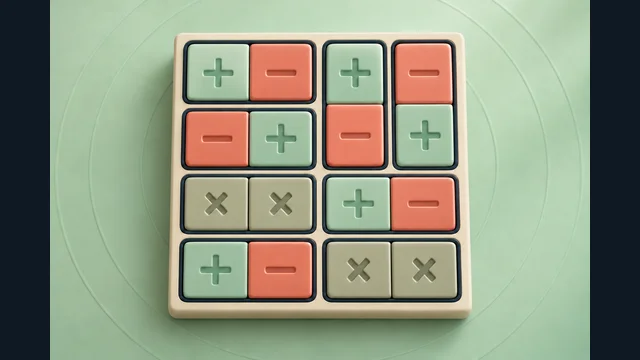
Magnets Puzzle is recorded as published in Zarocer's catalog on October 10, 2026, with reviewed version 1.0.0. Each outlined pair of squares can hold a magnet with one positive and one negative pole, or remain neutral. Numbers outside the grid specify how many poles of each type belong in each row and column. The result is a deduction puzzle whose pieces and constraints differ from ordinary number-placement games.
This release report describes the available campaign, daily mode, input methods and local continuation. It does not announce an online league or a future content update. The most important distinction for a first-time player is that the board is divided into pairs. You do not independently place a positive or negative symbol into any cell you like. Choosing an orientation changes both squares of the selected pair, and the counts must work together across the whole grid.
A pair can be positive then negative, negative then positive, or neutral. The interface also has an undecided state while the player works. Neutral and undecided are different: one is a completed decision that contributes no poles, while the other still leaves the pair unresolved. The native rules require every pair to be decided before the board is complete.
The English screenshot shows an introductory four-by-four puzzle with row and column clues, outlined pairs and a rules panel. It also shows how the interface separates the move count, time and completed-pair count. This is a real board from the reviewed build, not a decorative image made to resemble gameplay. Read the pair boundaries before considering a polarity; their orientation determines which rows or columns each decision can affect.
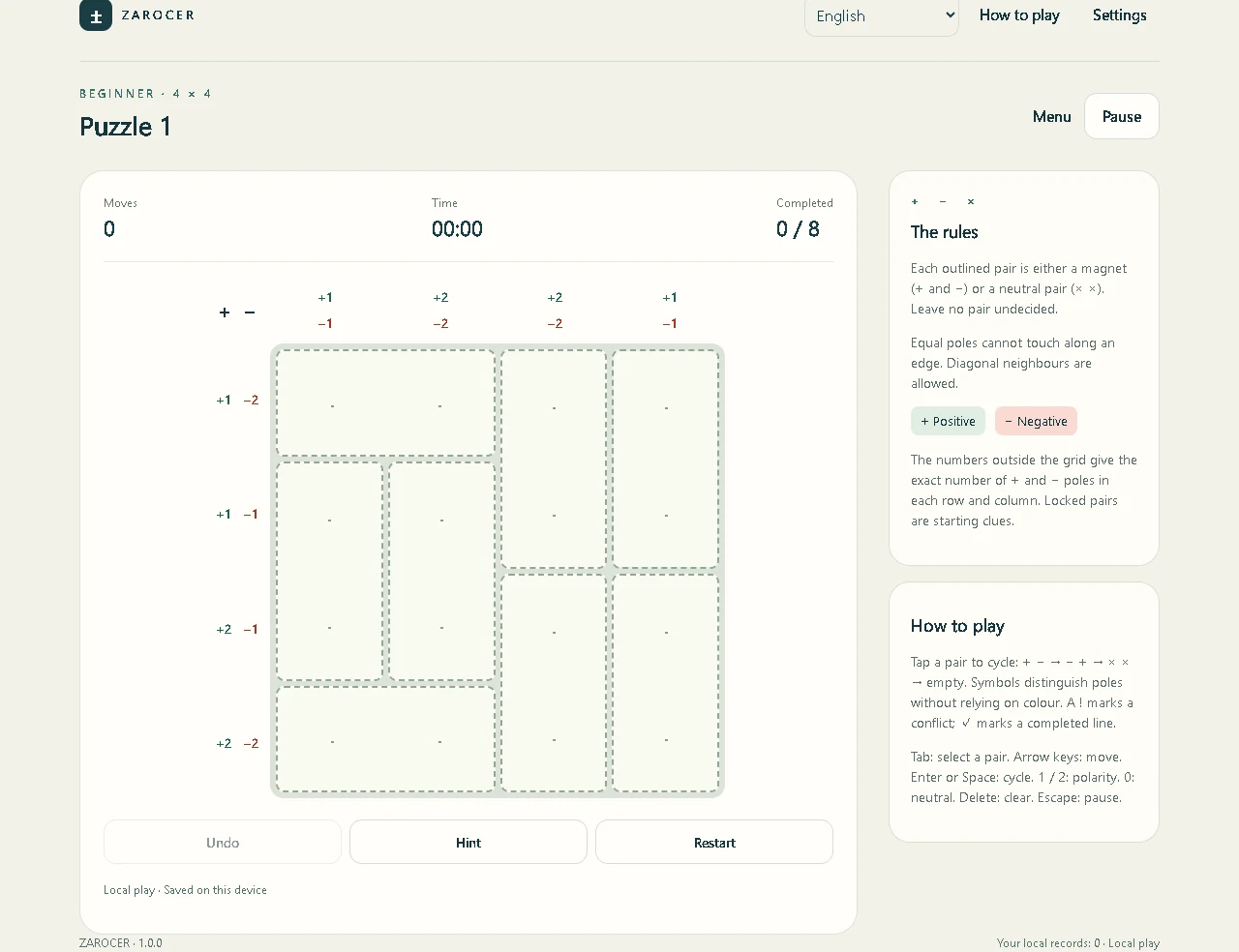
The positive and negative clues indicate exact totals, not minimums. If a row requires one positive pole, placing two positives there cannot be repaired simply by adding more negative poles. You need to reconsider which pairs contribute to that row. This makes counting a meaningful part of each move, particularly when a vertical pair contributes one square to one row and its other square to the row below.
Try separating what is already fixed from what remains possible. If a line has reached its required number of positive poles, any unresolved cell in that line cannot become another positive. That limitation can remove an orientation from a pair, which then affects a crossing line. The release provides a puzzle in which local choices have consequences elsewhere; repeatedly cycling a pair without checking those consequences is less informative than following the constraint that changed.
The adjacency rule prevents equal poles from touching along a side. Diagonal neighbors are allowed. This distinction matters because a dense board may place matching symbols near each other without violating the rule. Read the actual shared edge rather than judging proximity alone. A positive pole in one pair can restrict the nearby square of another pair, removing an orientation even when that second pair's row count still looks possible.
The included rules panel explicitly separates edge contact from diagonal contact. That helps players avoid an overly strict interpretation in which all nearby equal symbols are forbidden. It also shows why meeting the row and column totals is not enough on its own. A completed-looking count can still conceal a same-pole edge conflict, so the final check must consider both the totals and the neighboring cells.
The published campaign starts with four-by-four grids and progresses to six-by-eight puzzles. Larger grids provide more pairs and more crossing constraints to manage. This is a progression in board size, not a promise that every later puzzle introduces a new rule or that all difficulty comes from one numerical measure. The essential relationship between polarity, exact counts and adjacency remains the basis of play.
Beginning on a small board makes those relationships easier to inspect. Find a line with a restrictive clue, consider what its paired cells can contribute, and observe how a decision affects the perpendicular line. The native description states that mistakes can be corrected without losing lives. A learning session can therefore include revisions without turning every uncertain orientation into the end of an attempt.
The daily challenge selects a six-by-six puzzle for the UTC date and shares that board among players for the day. It offers a dated alternative to the campaign. The existence of the common board should not be expanded into an announcement of functioning portal-wide competitive rankings. The reviewed rules distinguish local assisted play from attempts eligible for competitive submission.
Hints, undo and restored games continue locally but cannot submit a competitive result under the documented behavior. Those limits matter because assistance is useful for learning even when it changes how an attempt is classified. A result label should describe what actually happened. This report does not imply that every daily attempt is uploaded or that a public leaderboard has been activated merely because the build contains eligibility rules.
Hints and undo are available when a player needs to reconsider a decision. A hint can reveal useful information, but the most valuable learning step is to connect that information with the row, column and adjacency constraints. After receiving assistance, inspect which alternatives it removes. That makes the next unassisted decision easier to explain instead of turning the hint button into a substitute for understanding the board.
Undo lets you return from an orientation that created a conflict and compare the previous position. The game also distinguishes neutral from empty, so restoring an earlier state can recover more than a visible plus or minus sign. Keep track of whether you are retracting a confirmed neutral pair or leaving it undecided. The meanings of those states are part of the logic, not just differences in how the cells are colored.
The screenshot's rules identify polarity with plus and minus symbols as well as different visual treatments. The published controls support mouse, keyboard and touch. Tapping a pair cycles its states, while the native instruction panel documents keyboard selection and polarity controls. Read that panel for the currently focused pair rather than assuming a key applies to whichever square you last looked at.
The symbols are particularly useful when color alone is not a comfortable way to distinguish poles. This report documents that visible interface feature without claiming a complete accessibility certification. A supported input method and a readable symbol are concrete capabilities; universal compatibility with every assistive setup would require separate testing. The playable page remains the appropriate starting point for checking controls on a particular device.
The build includes eleven languages and allows changing the interface without resetting the board. This is an in-game feature, not a new set of language-specific public URLs. Zarocer's portal remains English, and the catalog identifies one published game version. A change of language should not be mistaken for a new puzzle edition or an independent save system.
Progress is stored on the device when browser storage is available, and the game supports pause and continuation. Return using the same browser profile and domain. A favorite is a link back to the game, not a backup of a partly solved polarity board. This release report does not announce cloud saves, account synchronization or a migration of existing user data.
Magnets Puzzle complements number-placement and path games without using their rules. Futoshiki places values while respecting inequalities; Number Ladder builds an ordered route through cells. Magnets assigns paired poles and balances exact counts. Those differences provide a practical reason to choose among the games even when all appear in the Puzzle category. Category membership is a navigation aid, not a claim that their solution techniques are interchangeable.
Open Magnets Puzzle for the available build and begin with the small campaign board if polarity pairs are unfamiliar. Inspect the actual rules panel, keep neutral and undecided states separate, and follow the consequences of a single constraint. The catalog records the October 10 publication; this report provides context for that release afterward. Future features or competitive activation should be reported only when a later verified build establishes them.
Explore the new home for original game guides and practical browser gaming tips.
October 8, 2026 · ZarocerRead story
Two-column mobile category grids, a visual category directory and answers to common playing questions.
October 8, 2026 · ZarocerRead story
Flag Quiz’s October 10 catalog release brings 20-question rounds, 30 flags, missed-answer review and a UTC daily challenge. Explore the available build.
October 11, 2026 · ZarocerRead story
Explore Atlas Sprint’s October 10 catalog release: 93 selectable countries, continent practice, map controls and a 12-country daily challenge.
October 11, 2026 · ZarocerRead story
Untangle Puzzle’s October 10 release offers 24 Journey stages, a daily network and a 90-second mode. See the real English board and available controls.
October 11, 2026 · ZarocerRead story
Number Ladder’s October 10 catalog release brings checkpoint paths, a 12-level Journey, practice sizes and a shared daily 5 × 5 board.
October 11, 2026 · ZarocerRead story
Zarocer’s October 12 release adds Letter Hive, Word Quartets, Sentence Building and Typing Speed Race. Explore their distinct modes and launch limits.
October 12, 2026 · ZarocerRead story
Kōnane, Surakarta and Game of the Goose are now in Zarocer’s catalog. Compare movement systems, same-device play and the two Beta releases.
October 12, 2026 · ZarocerRead story
Tile Rummy 1.2.0 is live on Zarocer. Read the current variant, daily deal and reported old-save compatibility without changing the established game URL.
October 12, 2026 · ZarocerRead story