Portal news
The Zarocer blog is now live
Explore the new home for original game guides and practical browser gaming tips.
October 8, 2026 · ZarocerRead story
Untangle Puzzle’s October 10 release offers 24 Journey stages, a daily network and a 90-second mode. See the real English board and available controls.
By Zarocer · October 11, 2026 · 7 min read
Untangle Puzzle is recorded as published in Zarocer's catalog on October 10, 2026, with reviewed version 1.0.0. The task is to move numbered nodes until their connecting lines no longer cross or overlap and the nodes remain separated. Each node retains its connections when moved. You are reorganizing the drawing of a network, not deleting the relationships that make the puzzle challenging.
The release provides a twenty-four-stage Journey, a daily puzzle and Against the Clock mode. This report explains those available formats and the interaction visible in the reviewed English build. It does not announce future levels, online multiplayer or a public ranking service. The important first observation is that the puzzle concerns an arrangement: the same network can look tangled or clear depending on where its nodes are placed.
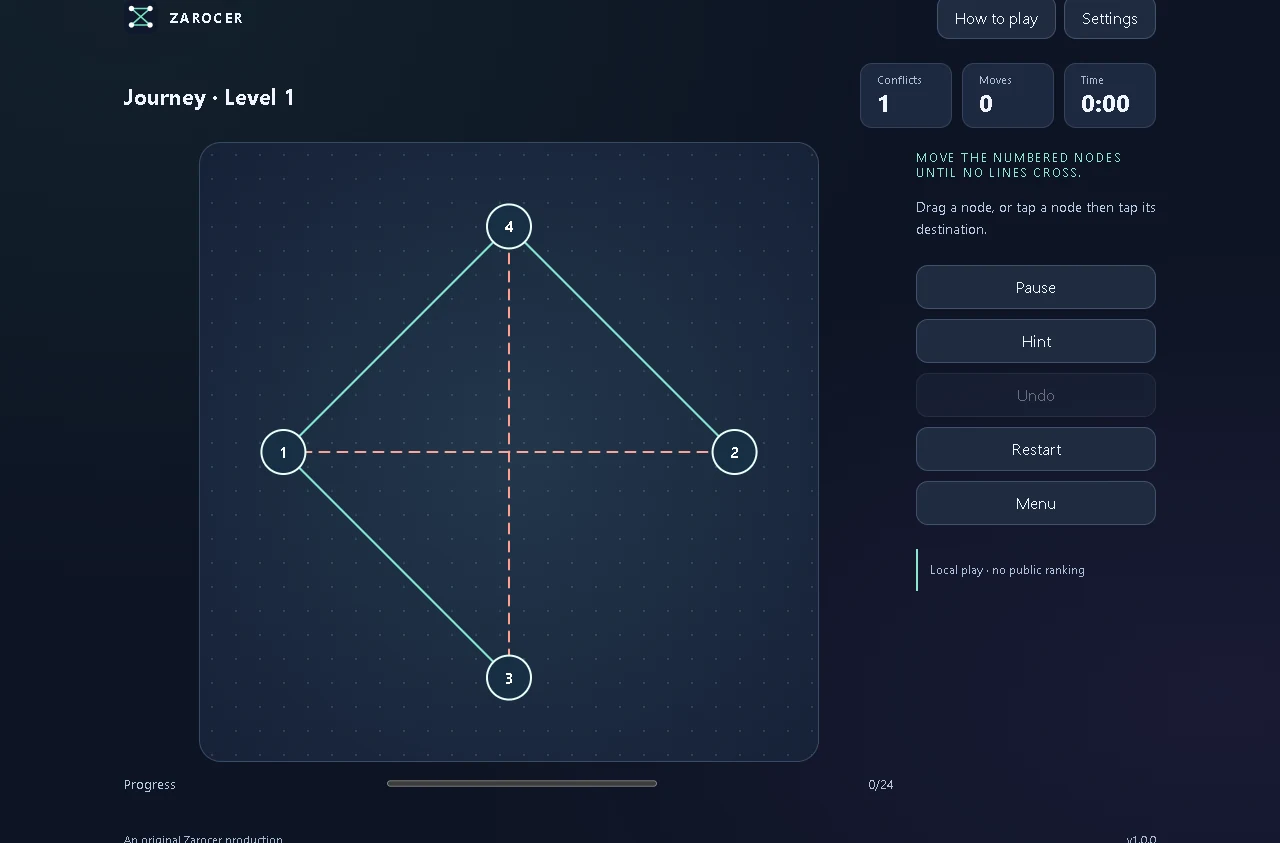
Dashed lines identify conflicts while you adjust the layout. The interface also displays a conflict count alongside moves and time. This feedback gives players a way to inspect what remains unresolved, but a move that lowers the count is not necessarily a complete plan. Moving one node can remove one crossing while creating another elsewhere, especially when several edges share that node.
The gameplay screenshot shows the first Journey level with four numbered nodes and a crossing between two dashed connections. It is a real state from the reviewed build. Trace which endpoints belong to each line before dragging anything. That simple reading task prevents a common misunderstanding: treating a line as a movable object independent of the nodes that define its endpoints.
Lines may meet at a node they genuinely share. That is different from two unrelated lines crossing in the middle of the board. A player who tries to separate every visible meeting would be trying to remove legitimate connections. The native rules distinguish those cases, so the goal is a readable arrangement of the existing network, not a picture in which no lines ever touch.
Overlap is another separate condition. Two connections can lie along the same segment even if their drawing does not resemble a simple X-shaped crossing. Nodes must also remain apart. These details explain why a board that looks nearly clear can still report a conflict. Inspect the remaining highlighted relationships instead of assuming that the counter is wrong because you can no longer see an obvious intersection at first glance.
Journey contains twenty-four stages, progressing from compact networks to boards with sixteen nodes. The published description establishes that progression without promising a fixed difficulty rating for each stage. A larger network creates more connections to track, but the layout and relationships also matter. The useful playing skill is learning to move a node while observing the edges it carries with it.
Early stages provide room to practise that skill without a deadline. Try moving one node into open space and watch how each connected line changes. If the move creates a new conflict, examine which endpoint relationship caused it. This gives the next adjustment a reason. Rapidly dragging several nodes can eventually produce a clear drawing, but it may leave you unable to explain why the result worked or how to approach the next stage.
Against the Clock gives ninety seconds to solve a network. It is a different session format from untimed Journey. The objective still concerns crossings, overlap and separation, but the time limit changes how long you can inspect alternatives. Learn the basic interaction before treating the timed mode as the default starting point. Familiarity with dragging and node selection matters when time is limited.
This report does not claim that the timed mode uses the same network as a particular Journey stage or that every completed run enters an online competition. The available catalog describes the mode and its duration, not a public tournament schedule. Keep the native session's result separate from portal-wide ranking claims. A countdown is an interface feature; it is not evidence that scores are being compared on a server.
The daily puzzle presents the same network for each UTC date. That provides a dated challenge alongside the permanent Journey progression and the short timed format. It does not mean the positions shown in this article will remain the starting arrangement tomorrow. A gameplay screenshot is an example from the reviewed version, while the daily selection belongs to a particular date.
Hints, undo and restored sessions make daily play local only under the documented rules. This distinction allows assistance to remain useful without treating an assisted attempt as equivalent to an untouched competitive submission. The current article does not activate or promise public rankings. If a future release changes competitive behavior, that deserves its own evidence and dated explanation rather than being assumed from the existence of a daily button.
Mouse users can drag a node. Touch users can also select a node and then tap its intended destination, which avoids relying exclusively on a continuous drag gesture. The published instructions support keyboard interaction with Tab, Enter and arrow keys, with Enter committing a move. Read the focus and selection cues so you know which node you are adjusting before changing its position.
These alternatives are important on smaller displays, where a finger can obscure part of the network. They describe available controls rather than a guarantee that every input setup has received full accessibility certification. The individual game page provides the place to check current device support. The puzzle's connections and success conditions remain the same across the documented input methods, so a new interaction method is not a separate edition of the game.
Undo can help compare two layouts after a move produces unexpected conflicts. Instead of merely retreating until the board looks familiar, inspect what changed in the lines attached to the moved node. A hint can provide assistance when you lose track of a useful direction, but the next learning step is still to examine how the arrangement resolves the conflicting relationships.
The native tools should not be expanded into features the release does not establish. This report does not claim a complete automatic solver, downloadable solution book or replay editor. It documents hint and undo controls in the available build. Their usefulness comes from helping you examine the board, not from guaranteeing that every possible intermediate arrangement can be turned into a record-setting result without further thought.
The published build includes eleven languages and allows switching without resetting the puzzle. Progress saves in the browser. These features provide continuity within the same reviewed release, not eleven public page versions or cloud synchronization. Return to Zarocer using the same browser profile when you want the native local progress to remain available.
Clearing site data can remove that local state. A favorite helps you navigate back to the game but does not copy a network arrangement or restore Journey progress after storage is removed. The release report does not recommend changing saves or manipulating result data as a learning technique. Normal play, undo and the existing controls already provide a safe way to investigate why an arrangement is or is not valid.
Untangle Puzzle does not ask you to place a missing number or balance a row total. Its numbered nodes identify points in a network whose geometry can change. Number Ladder instead builds an ordered path through fixed cells, while Magnets Puzzle balances paired polarities. These distinctions help players select a challenge based on the action they enjoy rather than treating all logic games as one interchangeable format.
Open Untangle Puzzle and try an untimed Journey stage before choosing the ninety-second mode. Trace shared endpoints, watch dashed conflicts and keep nodes separated. The published catalog date remains October 10, while this report records the available features for later readers. No future stage expansion or public competition is announced here; the current game page remains the reference for the version and controls you can actually play.
Explore the new home for original game guides and practical browser gaming tips.
October 8, 2026 · ZarocerRead story
Two-column mobile category grids, a visual category directory and answers to common playing questions.
October 8, 2026 · ZarocerRead story
Flag Quiz’s October 10 catalog release brings 20-question rounds, 30 flags, missed-answer review and a UTC daily challenge. Explore the available build.
October 11, 2026 · ZarocerRead story
Explore Atlas Sprint’s October 10 catalog release: 93 selectable countries, continent practice, map controls and a 12-country daily challenge.
October 11, 2026 · ZarocerRead story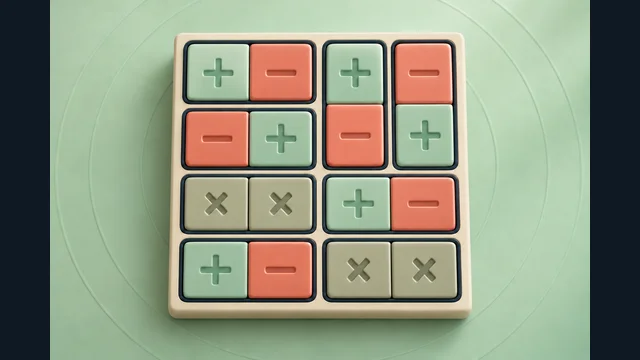
Magnets Puzzle’s October 10 catalog release combines paired poles, exact row and column clues, progressive campaign boards and a UTC daily puzzle.
October 11, 2026 · ZarocerRead story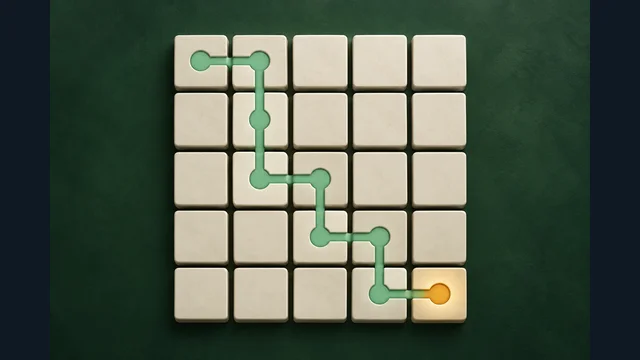
Number Ladder’s October 10 catalog release brings checkpoint paths, a 12-level Journey, practice sizes and a shared daily 5 × 5 board.
October 11, 2026 · ZarocerRead story
Zarocer’s October 12 release adds Letter Hive, Word Quartets, Sentence Building and Typing Speed Race. Explore their distinct modes and launch limits.
October 12, 2026 · ZarocerRead story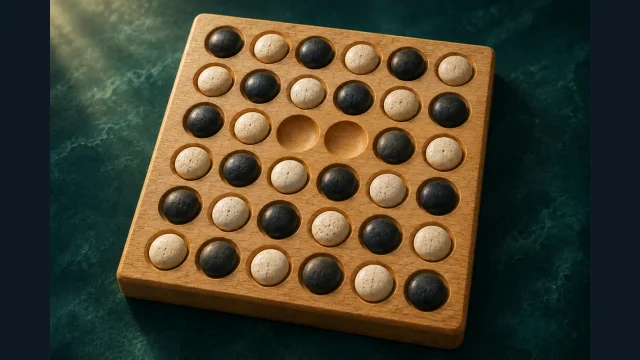
Kōnane, Surakarta and Game of the Goose are now in Zarocer’s catalog. Compare movement systems, same-device play and the two Beta releases.
October 12, 2026 · ZarocerRead story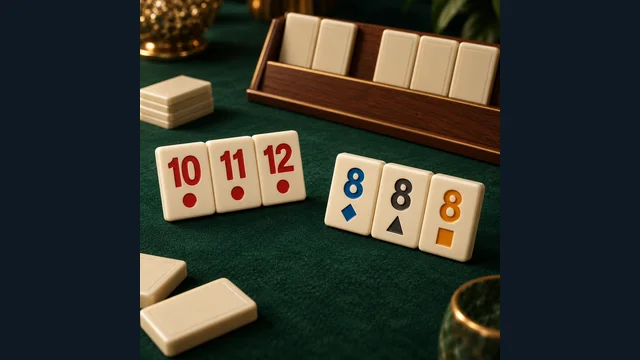
Tile Rummy 1.2.0 is live on Zarocer. Read the current variant, daily deal and reported old-save compatibility without changing the established game URL.
October 12, 2026 · ZarocerRead story